
#ICParkSM
New York has the worst organ donation rate in the country, and help is needed
Dressed in a hospital gown, Fred Knewstub, a retired Ithaca middle school teacher, lay in a room at Strong Memorial Hospital in Rochester, N.Y. for more than 10 months. His heart was dying, but his mind was very much alive. A disease called cardiomyopathy was causing congestive heart failure, robbing the Trumansburg resident and former marathon runner of his races and putting him on the list of candidates for an organ transplant. On April 16, 2014, Knewstub received a new heart.
“I think I’m going to appreciate life more,” he said.
Knewstub is not alone. Nearly 123,000 people in the United States are waiting for organ transplants, with New York residents accounting for 10 percent of the waiting list, according to data compiled by Excellus BlueCross BlueShield.
April is Organ Donation Month, but there is a major donor shortage. Despite needing so many transplants, New York has the lowest percentage of residents registered as organ donors in the country. It ranks dead last compared to other states, according to LiveOnNY, a nonprofit that helps facilitate organ transplants.
The organization found 83 percent of New York residents support organ donation but only 24 percent are registered donors. Tompkins County is an anomaly, with 40 percent of adults registered as donors—the highest number of any county in the state.
“While it takes 60 seconds to sign up on the registry in Texas, it takes more than 20 minutes in New York,” said Julia Rivera, the organization’s communications director. “In the current fast-moving technological environment, no one wants to wait that long to sign up on a registry.
More than 6,000 Americans died waiting for transplants in 2013, according to Excellus.
New York requires donors to be 18 years old to register, while other states place no age limits, Rivera said. There is less awareness about organ transplants because there has not been an extensive campaign by the government to garner more registered donors, she said.
“I wish it were more a part of driver education, so young people were thinking about it as well,” Knewstub’s wife Linda said.
Recently, LiveOnNY has succeeded in registering more people as donors.
“In the last three years, in collaboration with other recovery organizations, we have seen a 56% increase in enrollments statewide,” Rivera said.


Activists like Knewstub are working to improve New York’s reputation. April 16 marks one year since Knewstub got his new heart.
“I feel blessed,” Knewstub said. “If there is anything I can for this cause or any cause, I feel a responsibility to do what I can.”
Knewstub still has a long recovery ahead of him but said he feels much stronger now and even started jogging a bit. While the former teacher knows nothing about the person who gave him the gift of life, he said he would like to meet the individual’s family one day.
“Give it serious thought because it’s not just that individual that needs that organ,” Knewstub said. “That person has a whole extended family, people who love him…it’s a larger gift than you realize.”
Two level 3 sex offenders to move in to group home in Danby
More than 130 people signed a petition to prevent two level 3 sex offenders from moving into a group home in the town of Danby.
Megan Hall, who lives in Danby, started the online petition on Change.org, asking Unity House, a nonprofit that works with people with mental disabilities, not to move the registered sex offenders into a home at 168 Nelson Road near two schools.
“I think everybody’s main priority right now is to stop it,” she said.
But, neighbors and the town board have their hands tied because of a February ruling in New York’s highest court. A unanimous ruling Feb. 17 by the New York Court of Appeals overturned more than 100 local ordinances across the state that restricted where sex offenders could live. As a result, it is legal for the two level 3 sex offenders to live in the Nelson Road house, which is less than a mile from Ithaca Waldorf School.
“The town has no laws prohibiting this. It’s just dictated to us by the state,” Town Supervisor Ric Dietrich said during a March 16 town hall meeting.
There is no legal requirement that Unity House notify residents that sex offenders are moving in either. The organization, however, said it opted voluntarily to notify residents by distributing postcards and talking with immediate neighbors on Nelson Street.
“I understand what the concerns are, and I understand this is a highly emotional topic,” Elizabeth Smith, executive director of Unity House, said.
The sex offenders are expected to move in between late March and early April. Level 3 is the most severe sex offender designation.
Unity House will employ at least 9 direct-care counselors, she said, who will help supervise the two sex offenders, and a third man, 24/7 to prevent them from leaving the home on their own. At least two staff will be on duty at all times, and all doors and windows will also be alarmed to prevent one of the men from sneaking out, Smith said. Both the Tompkins County Sheriff’s Department and Unity House said an individual had never escaped from one of their facilities and reoffended.
Unity House took questions from Danby residents during the packed meeting at town hall, but the answers did not quell many residents’ fears.
“You’re using our friends and neighbors as bait,” Danby resident Raymond Mayo said.


Hall, who has two young children, said she won’t walk by the house with her kids anymore.
“It’s a sensitive issue,” she said. “We have a neighborhood where there are kids, families and nobody wants pedophiles living in your neighborhood.”
But, Hall and others said their biggest grievance was a lack of transparency on the part of unity house and that the postcards were not enough.
“Unity House should have been transparent from the beginning—at least to give the community and opportunity to get together, to inform them,” Hall said.
Neither of the two sex offenders has been given a “sexually violent offender” designation, which would be attached to their level III statuses. However, it is unclear what crimes either man committed. The sheriff’s department will publish that information after the men move to Unity House.
While Unity House said one of the men’s crimes was committed roughly 20 years ago and the other’s committed about three decades ago, the organization will continue to speak with residents and answer questions in an attempt to make everyone feel safe and comfortable in the community.
“We will go back to the agency and have a lot of discussion about what we could have done better,” Smith said.
Rape survivor copes through comedy
Ithaca, N.Y. – To anyone else keeping warm at the bar, it looked like an average night of drinks between two old college friends, reunited at their alma mater on a cold winter night in Ithaca. But, looking back to that January 2014 evening, Molly McDowell knows the man buying her alcohol had a much more calculated plan in mind.
“It’s absolutely infuriating,” McDowell said. “When I first found out they weren’t going to press charges, I just burst into tears. In that moment, it felt like my life was over.”
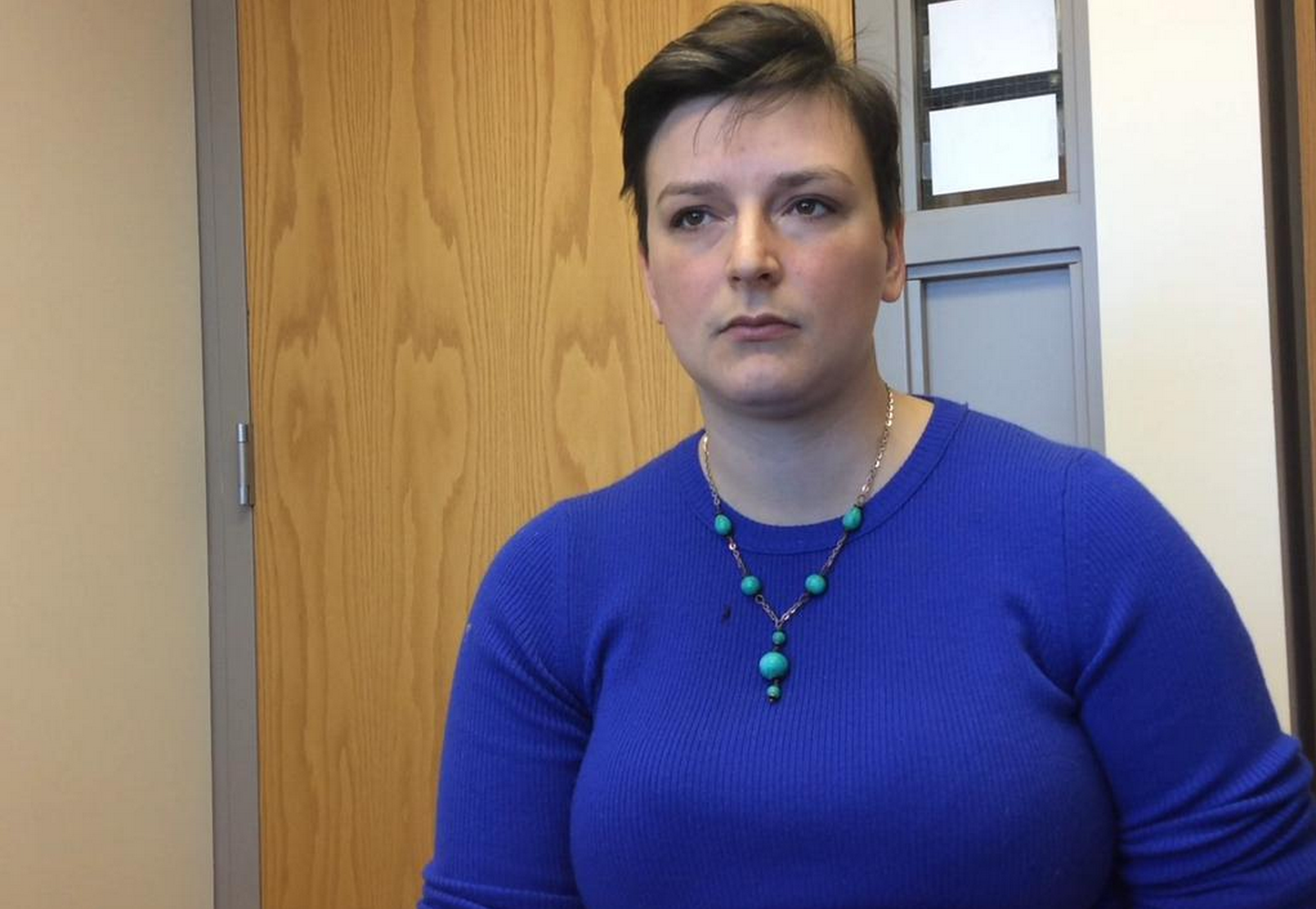
McDowell said a former Cornell Hockey player, who she has known since college, raped her last year. They first met when she was only 18 years old. She is 33 now, and though the scar is still fresh in her mind, she is choosing to cope through comedy.
“I found myself just cracking jokes about it in a really, really dark way—obviously—because there’s no light way to make jokes about rape,” she said.
Throughout February, McDowell has performed a comedy set about the assault at venues around central New York. On Feb. 11, she took the stage at Lot 10 Bar and Lounge on South Cayuga Street in Ithaca.
“This is something that we should be talking about. I want it to be a conversation starter,” she said.
The man she said raped her will never spend time in prison due to a lack of physical evidence. But, McDowell has channeled her frustrations into the routine and feels satisfaction knowing her alleged attacker has seen video of her set.
“She gets the best response at the open mics because that crowd understands that her set is a work in progress and they have more respect for comedy as an art form and humor as a coping mechanism,” said Francisco Ruben Arce, who has run open mic nights at Lot 10 for nearly three years. “I’ve seen audiences stay almost silent throughout her set and I’ve also seen them laugh heartily.”
Only about 30 percent of rapes are reported to police and of total rapes only about 7 percent lead to an arrest, according to the Justice Department. McDowell, who worked for a domestic violence organization before moving to Ithaca from Connecticut, did not report her rape at first. It was only after confiding in a friend that she got the Cornell University Police involved. Even though the department was unable to build a case that would put her attacker away, McDowell had nothing but kind words for the investigators.
“I don’t think most law enforcement agencies take rape and sexual assault seriously, but I think Cornell does,” she said.
One of the investigators later accompanied her to civil court, where she successfully got an order of protection against the alleged perpetrator.
“The safety, health and well-being of the victim is of the utmost importance,” Kathy Zoner, chief of the university’s police force, said. “The recounting of the sexual assault alone can be traumatizing, and there are certainly aspects of evidence gathering that can be very difficult for victims of sexual assault, even when done well and with great care and compassion.”
McDowell understands why some people might not watch her set, especially if they are victims themselves.
“It’s my story. It’s my journey, and this is what I’m choosing to do with it,” she said.
Moving forward, McDowell said, she hopes there will be more education in schools about consent.
City ramps up drug policy reform efforts
Ithaca Mayor Svante Myrick and community leaders have stepped up efforts to reform local drug enforcement policies, as part of an ongoing attempt to curb substance abuse, most recently the use of heroin.
The mayor hosted a packed free screening at Cinemapolis on Feb. 16 of the documentary “The House I Live In,” which earned Grand Jury Prize at the Sundance Film Festival in 2012 for its critical examination of the war on drugs. During the subsequent panel discussion, Myrick said members of the Ithaca Municipal Drug Policy Committee — which he formed in September 2014 to revise local drug policies — have made significant progress in their efforts to produce solutions that will be proposed this spring.
“The police chief has been very active in our committee as well as the district attorney,” Myrick said. “And once they come up with their recommendations, we’re going to take those to the police department.”
Law enforcement officials, as well as health care providers, social service workers and stakeholders from the private sector are part of the committee. A small group of them traveled to Seattle to explore a new pre-booking program known as Law Enforcement Assisted Diversion, which gives police officers the option to redirect low-level drug offenders to rehabilitation centers instead of jail, the mayor said.
“You’re just getting people directly into help,” Myrick said. “And in Seattle, they’re seeing great progress with it and we’re very interested in that.”
The Ithaca Police Department said its officers abide by a zero tolerance policy and give violators the maximum charge when practical. Plea bargains, the department said, can frustrate law enforcement.
“We don’t want to send the message that we’re pissed off at the courts or the courts are useless and they just let anybody walk free,” Jamie Williamson, the department’s public information officer, said. “But, on the same token, there are times when we’re frustrated with what a judge or what a district attorney’s office will do. We have seen cases where we’ve put in a significant amount of investigative legwork, and the case ends in what we deem to believe a weak sentence.”
But, criminalization, the mayor said, has not solved the problem. Although the city police department’s record-keeping system does not distinguish between drug and alcohol offenses, heroin has become more prevalent.
“Especially over the last 20 years, we’ve seen a steady increase in heroin possession, heroin overdoses and heroin sales here in the city,” Williamson said.
Preventative measures could bridle deaths from heroin overdoses, which have risen more drastically in the northeast than any other region in the United States, according to an October 2014 CDC report. First-time experimentation with the drug nearly doubled between 2007 and 2012, the Substance Abuse and Mental Health Services Administration said, from 373,000 to 669,000 reported uses.
“It’s how available it is,” Bill Rusen, CEO of Cayuga Addiction Recovery Services said. “And we’ve had a couple of overdose deaths. We had them in a very compressed period of time. I think we had two in about 48 hours. And that will scare the heck out of a community, no matter how big it is.”
Marijuana and alcohol abuse services still account for the lion’s share of the treatments Rusen’s office provides. Heroin presents problems, Rusen said, because the physiological addiction leads to symptoms that are more difficult to manage.
People need to engage in conversations on drug policies in order to bring about change, Travis Brooks, program administrator for the Greater Ithaca Activities Center and moderator of the panel, said.
“I think there’s opportunities for people to show up, they’ve just got to show up,” Brooks said.
 Stephen Adams